
Drywall Repair & Patching in Dallas, GA
Dallas is the Paulding County seat, about twenty minutes from the shop, and its housing splits in two: an old core around the courthouse square and a wall of post-2000 subdivisions from the years Paulding was one of the fastest-growing counties in the country. That newer stock is the bulk of the work now, and it is the same builder-grade construction the crew already paints in Hiram and Powder Springs — just reaching its first repaint and first remodel a few years behind them.
Paulding County · about 20 minutes from our Powder Springs shop
Drywall Repair & Patching for Dallas homes
Three layers. Around the courthouse square sit genuinely old wood-frame houses from the late 1800s through the 1920s — weatherboard siding, wood sash and deep trim that need carpentry and real prep, often over lead-era coatings, before any topcoat. Scattered between are 1960s-through-80s brick ranches and split-levels on larger lots. The bulk, though, is post-2000 neo-traditional subdivisions, and because the county grew so fast they are aging as one wave: builder-grade hardboard and Masonite lap siding, some early fiber-cement among it, is reaching the age where Georgia humidity ends it, the pressure-treated pine decks are spent, and the first kitchens and baths are due their remodel.
Areas we work in Dallas
- Downtown Dallas
- Brookside
- Seven Hills
- Allens Creek
- Riverwood
Near Paulding County Courthouse, Dallas Theater, Sara Babb Park and across the rest of Dallas.
Drywall Repair & Patching on Dallas houses
Dallas drywall work sorts by where you are standing. The bulk is in the post-2000 neo-traditional subdivisions, Seven Hills, Allens Creek and Riverwood among them, builder drywall that is aging as one wave and now showing nail pops, seam cracks and knockdown ceilings that need matching rather than smoothing. Scattered between are 1960s through 80s brick ranches and split-levels, ordinary drywall of their era. Around the courthouse square the stock is genuinely old wood-frame from the late 1800s through the 1920s, and there a wall repair is usually plaster over wood lath, not drywall at all, cracking along the lath and at stress points and taking a plaster repair rather than a mud skim. Knowing which of the three you are in decides the whole approach.
What usually gets missed
The miss in the newer subdivisions is texture: fill a nail pop or a seam, roll it flat, and it reads as a smooth patch in a knockdown field from across the room. Around the square the costly mistake is treating old plaster like drywall, skimming joint compound over a plaster crack that then reopens, because plaster on lath moves and has to be repaired as plaster. And in any of it, a water-stained ceiling gets painted before the source is found and bleeds back. Match the surface and fix the cause, whichever era the house is.
On a Dallas job we check
- Match knockdown texture over patches in subdivision stock
- Repair old-square plaster as plaster, not with a mud skim
- Find the leak before painting any stained ceiling
What the job actually involves
Most drywall repairs are judged on one thing: whether you can still see the patch afterward. Matching the texture and the surrounding wall is the hard part, not filling the hole. And a crack or water stain that keeps coming back is a sign of something behind the wall that has to be found before the drywall is closed up.
We use drywall that matches the thickness of your walls or ceiling, setting-type or lightweight joint compound depending on the repair, paper or mesh tape at the joints, and a stain-blocking primer on every patch and water stain, because primer is what keeps a repair from flashing a different sheen or letting an old stain bleed through. Texture is matched with the same method already on the wall.
How we run a drywall repair & patching job in Dallas
- 1
Find the cause before patching
We look at what caused the damage. A hairline crack over a door is usually seasonal settling and will hold once taped. A stair-step crack, or a door that no longer latches, can mean movement a patch will not hold, and we say so. A brown ring means water, and the leak gets traced and fixed before any board is touched, or the stain bleeds back through.
- 2
Open up and check what is behind the board
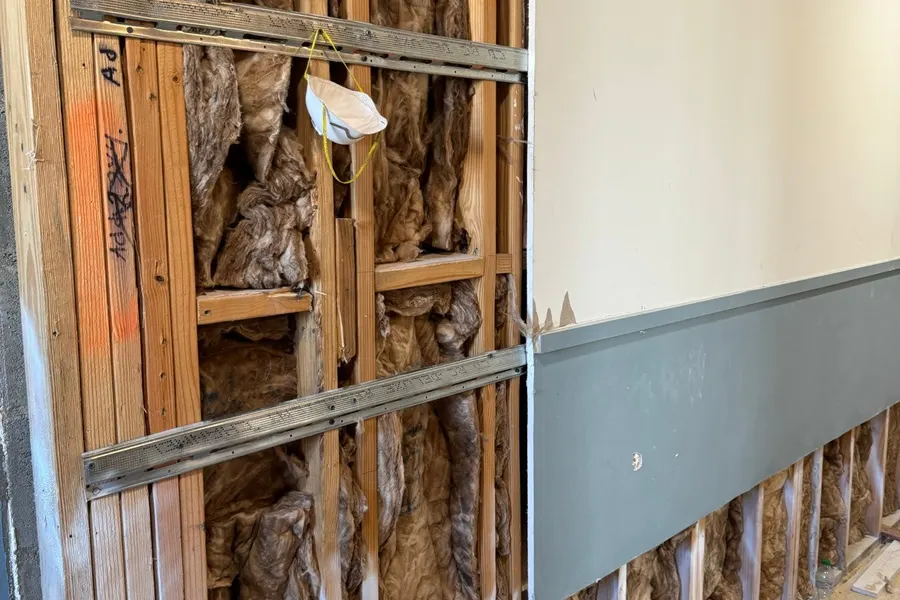
For water damage or a soft spot, we cut back to sound board and look at the framing, insulation and the back of the drywall. Wet insulation and moldy board come out rather than getting painted over. While the wall is open we confirm where the water came from, because closing it up over an active leak just buys a season.
- 3
Repair or replace the board
Small holes get a backed patch. A nail pop gets the fastener reset and re-secured to the stud, not just filled. A run of damaged or water-stained board gets cut out and replaced with new drywall of the same thickness. Replacing a sheet is sometimes cheaper and cleaner than chasing a patch across half a wall, and we will tell you which your wall needs.
- 4
Tape, coat and sand flat
Joints are taped and built up in coats, each wider than the last and sanded between, so the repair feathers into the flat of the wall instead of leaving a hump the light catches. In humid months each coat is given time to dry, because compound that is closed up damp lets the tape lift and blister later.
- 5
Match the texture
This is where most repairs show. Knockdown, orange peel and popcorn each get matched to the existing wall or ceiling rather than left as a smooth slick in a textured field. A patch that is flat and sound but the wrong texture still reads as a repair from across the room, so the texture is matched by hand before any paint.
- 6
Prime, paint and check in raking light
Every patch is spot-primed so it does not flash a different sheen, then the wall is painted, usually corner to corner because fresh paint rarely matches aged paint around a spot. We check the finished surface with a light held low and to the side, which shows any ridge or texture mismatch the overhead light hides, and fix it before the job is called done.
What moves the price
We will not quote Dallas blind over the phone — these are the things we look at on site that decide the number.
- How many repairs and how big. One ceiling stain is a small job. Nail pops and cracks in every room are a day or more of patching, sanding and texture work.
- What caused the damage. A clean hole is cheap. Water damage means tracing and fixing the source first, and that roof or plumbing work is separate from the drywall.
- Texture. Matching knockdown, orange peel or popcorn takes more time and skill than a smooth wall. Popcorn that may predate the mid-1980s should be tested for asbestos before it is disturbed.
- Patch versus replacing the sheet. Cutting out and hanging new board, then taping a full sheet, costs more than a small patch but is the right call when the damage is widespread.
- Ceiling versus wall, and height. Ceiling work is slower and harder to texture-match, and two-story foyers or stairwell walls need staging to reach safely.
- Repainting. A repair almost always needs the wall repainted corner to corner, because a dab of touch-up paint rarely matches the aged paint around it.
From a drywall repair & patching customer
“His crew and him, helped me and the family get our home painted and repairs that look like new. … He ended up replacing trim and sills around my home.”
Exterior repaint, trim and sills
Want a real number for your Dallas drywall repair & patching job?
The only way to price it honestly is to see it. We come out, walk the job and put it in writing — free, and with no obligation to book.
Call and we answer 24/7. Forms sent during the day get a call back the same day.
Drywall Repair & Patching in Dallas — questions we get asked
- Can you make the patch invisible?
- On a smooth wall, yes, with proper feathering and a repaint of that wall. On a textured wall or ceiling the goal is a match you cannot pick out from normal standing distance, since textures are matched by hand and a trained eye up close may still find it. Most repairs that show failed on the texture or on skipping the repaint, not on the patch itself.
- Why does the same crack keep coming back?
- Because the cause is still there. Hairline cracks that open and close with the seasons can be taped and will usually hold. A crack that keeps returning in the same spot often tracks structural movement, and no amount of compound fixes that. We tell you when a crack is cosmetic and when it points to something under the house that needs a look first.
- There is a brown stain on my ceiling. Do you just paint over it?
- Not until the leak is found and fixed. Painting a water stain seals it for a while, then it bleeds back when the next rain or the next leak hits. We find the source first, let the area dry, replace any ruined board, then prime with a stain blocker and repaint so it does not return.
- Can I just patch it myself?
- A small nail hole or a doorknob ding, yes, with filler, sanding and a little paint. Where people get into trouble is texture matching, taping a big joint flat, and water damage that looks small on the surface and is larger inside the wall. If a home patch is telegraphing through the paint, it is almost always the texture or the feather.
- Do you repair plaster too, or only drywall?
- Both. Older homes across the west-metro area, near the Marietta Square, around the Dallas courthouse and in the older Smyrna and Vinings cores, often have plaster over wood lath that cracks and lets go differently than drywall. A plaster repair is its own craft, so we match it rather than skim drywall mud over it and hope it holds.
Planning drywall repair & patching? Start here
- Why a drywall patch shows — and how texture matching hides it A patch fails to disappear because of texture and sheen, not strength — here is what it takes to make a repair vanish.
- A water stain on your drywall? Find the leak before you patch The stain is the symptom. Why finding the water source has to come before any compound, and how to repair it so it stays gone.
- Why drywall cracks, and which cracks actually matter Seasonal cracks patch and stay fixed; structural cracks come back. How to read the difference before you pay to repair one.
More in Dallas
Paulding County housing, neighborhoods and what we do there.
Painting & remodeling in Dallas →Other work in Dallas
Prefer to talk it through? Dan picks up.
(470) 419-0922