
Why a drywall patch shows — and how texture matching hides it
A patch fails to disappear because of texture and sheen, not strength — here is what it takes to make a repair vanish.
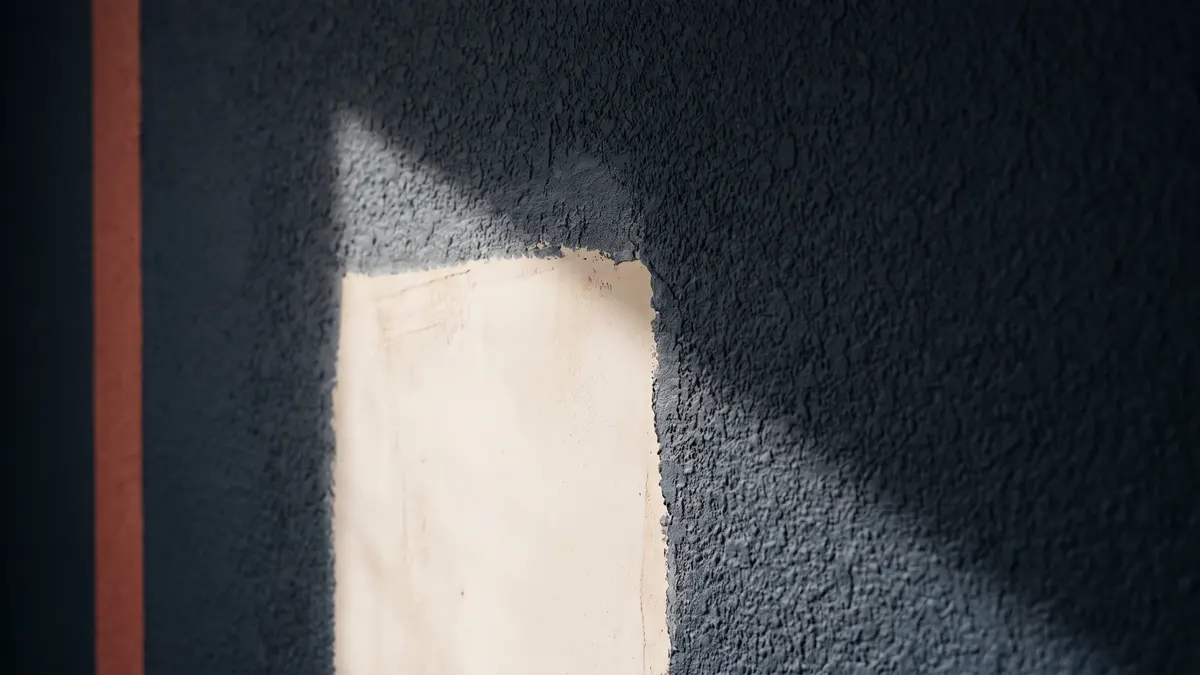
A drywall repair shows through because the texture does not match, not because the patch is weak. Most metro-Atlanta walls and ceilings are not smooth — they are knockdown or orange peel, sprayed on and then worked — so a troweled-and-sanded patch leaves a flat island that side light catches. Matching the surrounding texture, then priming the bare compound so it does not flash a different sheen, is what actually makes a sound repair disappear.
Planning drywall repair & patching in west metro Atlanta? Get a free written estimate.
The patch is the easy part; the texture is where it fails
Filling a hole and sanding it flat is straightforward. The reason a finished repair still jumps out at you is that the wall around it is not flat — it has a sprayed texture — and a smooth patch sitting in a field of texture reads as a flat island the moment light rakes across it from a window or a lamp. The structure of the repair can be perfect and the spot will still be obvious.
That is why texture matching, not patching, is the real skill in drywall repair. The goal is not a strong patch — any patch is strong enough — it is a patch you cannot find once the wall is painted and the afternoon sun comes across it.
First, know which texture you actually have
Most homes in the west-metro subdivisions have one of two sprayed textures. Orange peel is a fine spatter that looks like the skin of an orange, standard in a lot of 1990s and 2000s builder walls. Knockdown is heavier — sprayed on in blobs, then flattened with a wide knife so it looks like troweled plaster — and it turns up on great-room walls and ceilings of that era.
The older stock is different. Mid-century homes around Smyrna and Marietta often have smooth plaster or smooth drywall, and some 1970s-through-90s ceilings are popcorn. Each of these is matched a different way, so the first move on any repair is identifying what is already on the wall.
How orange peel and knockdown are actually matched
Orange peel is matched by spraying thinned joint compound through a hopper or an aerosol can, adjusting the droplet size and air pressure until the spatter matches the wall, then blending it past the edge of the patch so there is no hard line. Too wet and it runs; too dry and the droplets sit up too coarse.
Knockdown adds a step: the compound is sprayed, left to firm up for a few minutes, then knocked down with a wide blade. The timing is the whole game — knock it down too early and it smears into mud, too late and it will not flatten and stays as peaks. Matching an existing knockdown means matching both the spray pattern and how hard it was originally flattened.
Why the bare patch flashes even after the texture matches
There is a second way repairs show, and it survives perfect texture. New joint compound and fresh primer absorb paint differently than the aged, painted wall around them, so the repaired spot dries to a slightly different sheen — a dull halo you catch at an angle. Painters call it flashing, and it is a porosity problem, not a color one.
The fix is to prime the bare compound before painting so the whole area absorbs evenly, and often to paint the repair out to the nearest corners rather than stopping at the patch. On a wall where the existing paint has faded or the sheen has changed with age, painting the entire wall is sometimes the only way the repair truly disappears, and that changes what the repair costs.
Popcorn ceilings and old plaster are their own problem
A popcorn ceiling cannot be rolled back smooth to match — the acoustic texture is sprayed, so a patch has to be re-sprayed with matching material and aggregate. There is one serious caveat: popcorn in a home built before the late 1970s may contain asbestos, so it is worth testing before anyone scrapes or sands it dry, and leaving it alone if it does.
Plaster in the older mid-century homes behaves differently than drywall. It cracks along its own lines and is patched with setting-type compound rather than tape and mud alone, because a plaster wall moves and a paper-tape patch over it tends to reopen. Matching an old plaster finish is closer to a skim-coat than a drywall patch.
Questions we get asked
- Why can I still see the repair after it was painted?
- Almost always one of two things: the patch is smooth and the wall is textured, so it reads as a flat spot, or the bare compound was not primed and dried to a different sheen than the rest of the wall. Both are fixable — match the texture and prime the patch — but paint alone over a smooth patch will not hide it.
- Can you match the knockdown texture on my ceiling?
- Yes. Knockdown is re-sprayed and then flattened with a blade to match the existing pattern and how hard it was originally knocked down. Ceilings are less forgiving than walls because overhead light rakes straight across them, so the match has to be close.
- Do you have to repaint the whole wall?
- Sometimes. If the existing paint has aged or changed sheen, a primed and painted patch can still show as a slightly different tone, and painting corner to corner is the only way to make it uniform. On a recently painted wall in good shape, a spot-primed and spot-painted repair can disappear on its own.
- My ceiling is popcorn — can it be patched?
- It can be re-sprayed to match, but if the house predates the late 1970s the material should be tested for asbestos before anyone disturbs it. If it tests positive, the right move is to leave it undisturbed or bring in an abatement specialist, not scrape it yourself.
- Is orange peel or knockdown easier to match?
- Orange peel is generally more forgiving because it is a single spray step. Knockdown adds the timing of the knock-down pass, so it takes more judgment to match an existing wall, especially on a ceiling where the light is unforgiving.
Reviewed 2026-10-09 by Dan James, WS Painting & Remodeling LLC.