
Siding repair or full replacement: how to decide
The decision comes down to whether the material itself is still sound and whether you can match what is already on the wall.
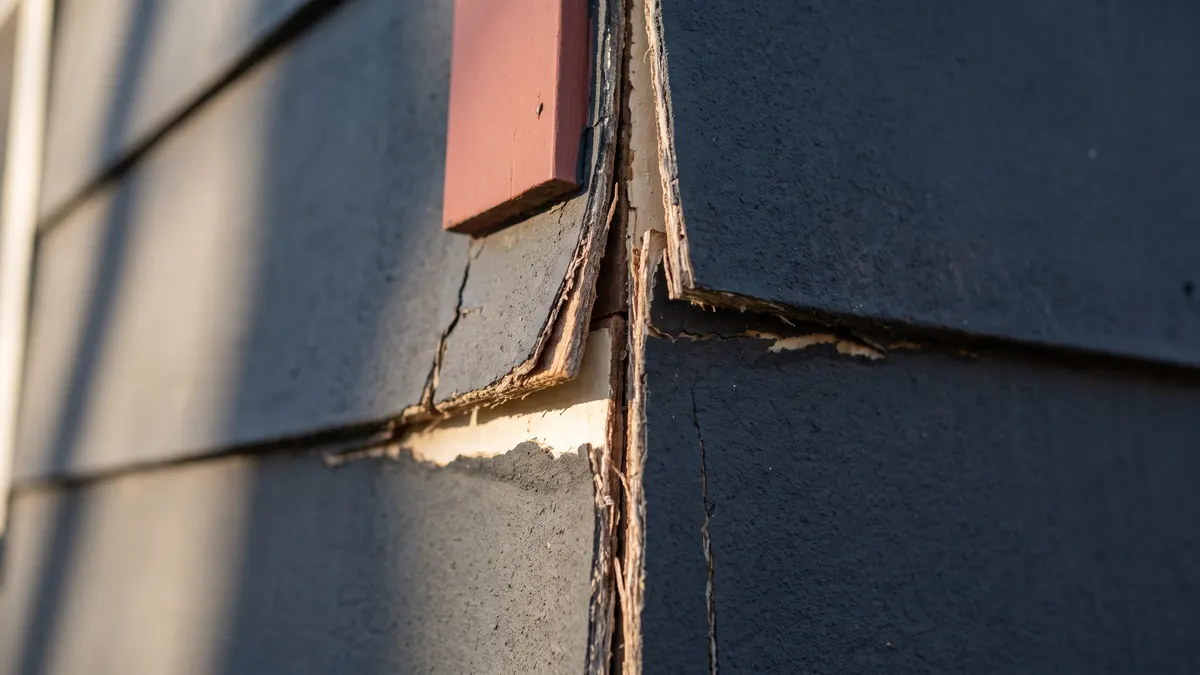
Repair the siding when the damage is isolated, the material around it is still sound, and the existing profile can be matched. Replace it when the material itself is failing — hardboard that has swollen and delaminated at the butt joints will not be saved by paint or patching — or when the profile is discontinued, because a visible patch on the front of the house becomes its own problem. Sound fiber cement that is only faded or chalked gets repainted, not replaced.
Planning siding replacement in west metro Atlanta? Get a free written estimate.
Start with the material, not the damage
Most homeowners frame this by how much they can see: a few bad boards means a repair, a wall of bad boards means replacement. That is the wrong first question. The first question is what the siding is made of and whether that material is at the end of its life, because that decides whether a repair fixes the problem or just postpones it.
On a west-metro Atlanta house, the siding tells you its own story. Builder-grade hardboard and Masonite lap siding went up across the 1980s and 90s subdivisions here, and in Georgia humidity it fails in a specific way: it drinks water at the exposed butt joints and the bottom course, swells, and delaminates around the nail heads. Once that has started on an elevation, swapping a few boards does nothing for the boards beside them that are a year or two behind.
When a repair is genuinely the right call
Repair makes sense when three things are true at once: the damage is isolated, the material around it is still sound, and the profile can be matched. A truck backed into one corner, a limb cracked two panels, a failed downspout dumped water on one spot below a roof line — those are repairs, and treating any of them as a whole-house job wastes money.
Fiber cement earns its own mention. It is a long-lived material, and when it looks tired it is usually the paint that has failed, not the board. Chalked, faded fiber cement that is still flat and firmly fastened does not need replacing. It needs washing, priming where the coating has worn through, and repainting. Paying to replace sound fiber cement because it looks dull is paying to solve a problem a repaint already solves.
- Isolated impact damage — a cracked or holed panel from a limb, a ladder or a vehicle.
- One wall that took concentrated water from a failed gutter while the rest of the house stayed dry.
- Fiber cement that is faded or chalked but still flat, sound and firmly fastened — a paint problem, not a siding problem.
- A short run of loose or lifted siding where the fasteners let go but the board itself is intact.
When the material itself is the problem
Replacement becomes the honest answer when the failure is the material, not an event. Hardboard that is swelling and crumbling at the joints has reached the end of its service life, and it is failing everywhere the sun and rain reach it — not only where you first noticed. Patching it turns into a standing appointment: you are back at a different wall next year, paying each time for setup, matching and paint.
The tell is repetition. If the same house has needed siding attention in three different places in a few years, the system is aging out, and continuing to patch costs more over time than replacing it once and being done. Widespread warping, buckling, soft spots you can push a screwdriver into, and moisture staining that keeps returning are the same signal.
The discontinued-profile trap
There is a specific way a small repair becomes a big one, and it catches people off guard. Siding profiles, textures and colors get discontinued. If the exact lap height and texture on your house is no longer made, a structurally perfect repair still reads as a patch, because the new boards sit differently in the light next to twenty-year-old originals that have faded.
When that happens the choices are narrow, and worth understanding before you start. You can re-side a whole elevation so the change lands at a corner rather than in the middle of a wall, which is why a repair on one face sometimes grows into re-siding that face. On a house where the front is brick with sided gables and a sided rear wall — common in the 90s stock here — that often means re-siding the gables and back and leaving the brick front alone. What you cannot do is make a discontinued profile match by eye in the middle of a visible wall and expect it to disappear.
What is behind the siding decides it
Siding is the outer layer of a water-shedding system, and the most expensive mistake is treating a water problem as a cosmetic one. If water has been getting behind damaged boards, the question stops being about the siding and becomes about the sheathing, the framing and the wall below. In this climate that damage collects in predictable places: under windows, below roof-to-wall junctions, and along the bottom course near grade.
This is why the useful first step is an inspection, not a quote for a job already decided. A proper look checks the field of the siding, the corners and seams, the areas around every opening, and the lowest courses — and it asks the matching question honestly: if only part is replaced, will the house read as one house or two. If the damage is contained and matchable, repair is the better value. If the material is aging out or hiding rot, replacement protects the wall and leaves you one consistent exterior instead of a map of patches.
Questions we get asked
- Can I just replace the damaged boards myself to save money?
- You can, for genuinely isolated damage on a sound wall. The two things that trip up a spot repair are matching the profile and getting the laps and flashing right so water still sheds outward. A patch that looks fine but lets water in behind it costs far more than it saved.
- My siding just looks faded. Do I need to replace it?
- Usually not. Fading is a coating problem, and on sound fiber cement, wood or many older boards, washing and repainting restores it. Replace for fade only when the material under the color is also failing.
- How do I know if the damage is hiding rot behind it?
- Soft or spongy siding, staining that keeps coming back after painting, and damage concentrated under windows or below roof lines are the warning signs. The only way to be sure is to open a section and look at the sheathing, which is part of what an inspection should cover.
- Is it worth repairing siding on a house I plan to sell?
- A clean, consistent exterior helps, and a tidy repair on sound siding is worth doing. A visible mismatched patch can read worse than the original damage, though, so if the profile cannot be matched it is worth weighing re-siding the affected elevation instead of patching a face a buyer will stand right in front of.
- Can you match my siding color if it has faded?
- Paint can be matched closely to the current faded color, but a factory-finished board in the original color will not match a wall that has aged in the sun. That is the practical reason a repair on paintable siding is easier to blend than one on factory-colored material you cannot repaint.
Reviewed 2026-10-09 by Dan James, WS Painting & Remodeling LLC.