
Choosing siding that holds up in Georgia
Which materials earn their place on a Georgia house, and why the water-shedding details behind them decide how long the job lasts.
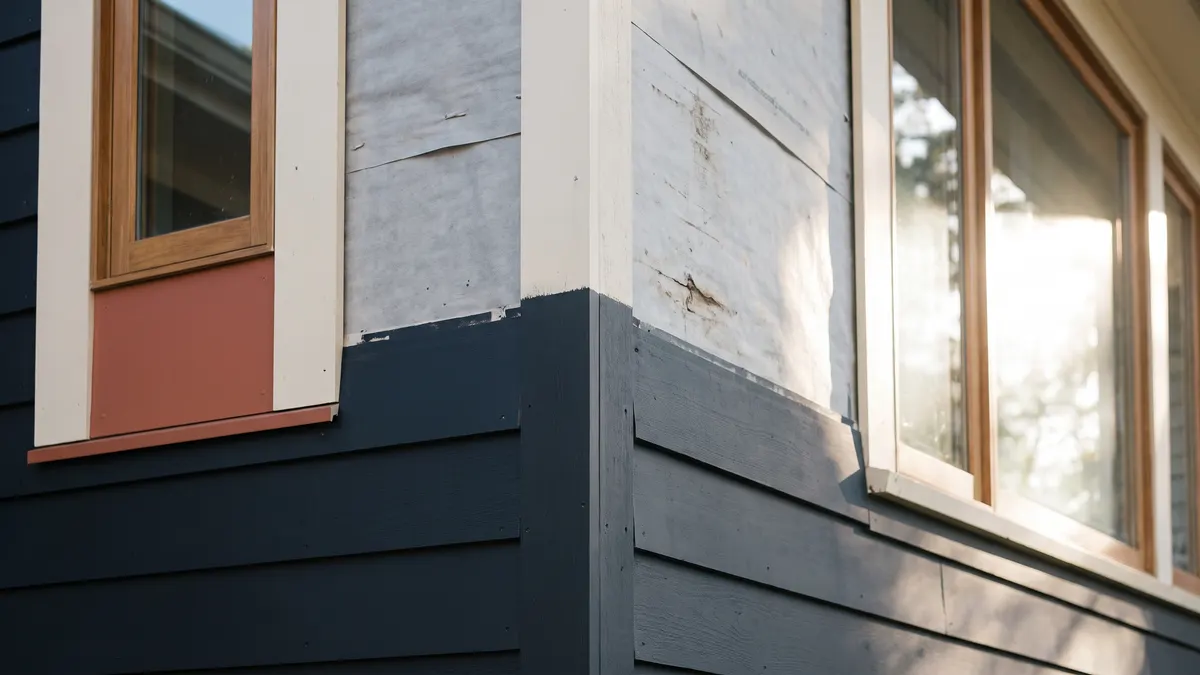
For a Georgia re-side, the material matters less than how the wall is put back together behind it. Fiber cement and quality vinyl both hold up well in the heat and humidity here; the failures come from vinyl nailed too tight so it buckles in summer, and from missing flashing at the windows that lets water rot the sheathing. Pick a material for the upkeep you are willing to do, then put your attention on the weather barrier, the flashing and the expansion gaps, because that system is what actually keeps water out of the wall.
Planning siding replacement in west metro Atlanta? Get a free written estimate.
The material choice, honestly
Once you have decided to re-side rather than patch, the material question is real, but it is narrower than the brochures make it. Three materials cover most west-metro houses, and each one is a trade between upfront cost, upkeep and how it handles Georgia weather.
Whatever you choose, the thing that ends siding early here is not usually the board — it is water getting behind it and heat moving it. Keep that in mind as you read the tradeoffs, because it reorders the priorities.
- Vinyl: lowest upkeep and lowest upfront cost, and it does not rot or feed termites. It has to be hung loose so it can move, and cheaper panels can fade or look thin on a larger facade.
- Fiber cement: holds up well in sun and humidity, resists rot and insects, and takes paint beautifully — but it is heavier, needs careful cutting with dust control, and wants repainting on a cycle.
- Engineered wood: lighter than fiber cement and takes paint well, with better impact resistance than vinyl. It depends entirely on its coating and sealed edges staying intact, which matters more in a wet climate.
- Brick and existing masonry: not something you re-side, but worth noting — many 90s houses here are brick front with sided gables and a sided rear wall, so the job is only the sided portions.
What actually fails on a Georgia wall
Heat is the first enemy. Vinyl expands and contracts a surprising amount between a July afternoon and a January night, and if it is nailed tight to the wall it has nowhere to go, so it buckles and waves. Correct installation leaves the nails slightly loose and the panels free to slide — a detail you cannot see once it is up, but one that decides whether the wall still looks flat in three summers.
Water is the second. Siding does not keep water out on its own; the weather barrier and the flashing behind it do. The failures we find on tear-off are almost always at the openings — windows and doors that were never properly flashed, so years of wind-driven rain ran down into the sheathing below the sill. That is the damage that turns a straightforward re-side into sheathing and framing repair, and it is the reason the flashing is worth more attention than the color.
The part of the quote that decides the outcome
Two quotes for the same house can be built on very different assumptions, and the gaps are rarely in the siding itself. Ask what happens if rot turns up once the old siding is off, because on older stock it usually does somewhere, and a quote that pretends it will not is a quote that will change mid-job.
Ask who flashes the openings and how, whether house wrap or building paper is being replaced or reused, and — if you are going with fiber cement or engineered wood — whether priming and painting are in the number or a separate line later. For the cost ranges behind these choices, see the siding replacement cost guide rather than trusting a figure quoted off the cuff.
Matching the house you have
Siding reads best when it fits the house rather than fighting it. On the 90s subdivision stock across the west metro, that usually means matching the existing lap height and keeping the corner boards, window trim and fascia detailing consistent, so the rebuilt walls still relate to the brick front. Skip that and the house looks re-sided in the worst way — like three separate decisions that never met.
Older homes closer to the historic cores ask for more care. Weatherboard houses from the early 1900s have a proportion and a trim profile that modern panels can flatten, so matching the reveal and keeping the original trim lines matters more there than any single product spec.
Sequence, timing and staying weathertight
A re-side exposes the wall, so the working rule is that the house goes back to weathertight at the end of each day rather than sitting open overnight. That shapes how the job is sequenced — one elevation at a time, wrapped and closed before the crew leaves — and it is worth confirming that is the plan.
If your neighborhood has an architectural committee and the color or material is changing, start that approval early, because it runs on the committee's schedule, not the crew's. You can run the approval in parallel with getting quotes rather than discovering at the start date that it has not gone in.
Questions we get asked
- Which siding lasts longest in Georgia's climate?
- Fiber cement and quality vinyl both do well here against heat, humidity and termites. Fiber cement generally lasts longer and takes paint, at a higher upfront cost and with repainting on a cycle; good vinyl lasts a long time with almost no upkeep. The bigger variable is the install, not the material.
- Can new siding just go over the old siding?
- Sometimes, but it is usually the wrong call on older stock, because it hides whatever is happening to the sheathing and flashing underneath. Taking the old siding off is how hidden water damage gets found and fixed, which is often the main reason to re-side in the first place.
- How long will my house be opened up during the work?
- Only within the working day. A sound approach wraps and closes each elevation before the crew leaves, so the house is weathertight every night even though the project runs over one to three weeks depending on size, material and weather.
- Does fiber cement need painting after it goes up?
- Unless it comes pre-finished, yes — it is primed and painted as part of the job, and it will want repainting on a cycle down the road. That upkeep is the trade for how well it holds up, and it is worth factoring in rather than being surprised by later.
- Is it worth adding insulation while the siding is off?
- It can be, since the wall is open and accessible, but it depends on what is already there and what you are trying to fix. It is a reasonable thing to ask about and price as an option, not something to assume every house needs.
Reviewed 2026-10-09 by Dan James, WS Painting & Remodeling LLC.