
How to match cabinets and wall colors without a busy kitchen
Why the cabinets set the palette, how undertones decide what works, and when to let the walls simply get out of the way.
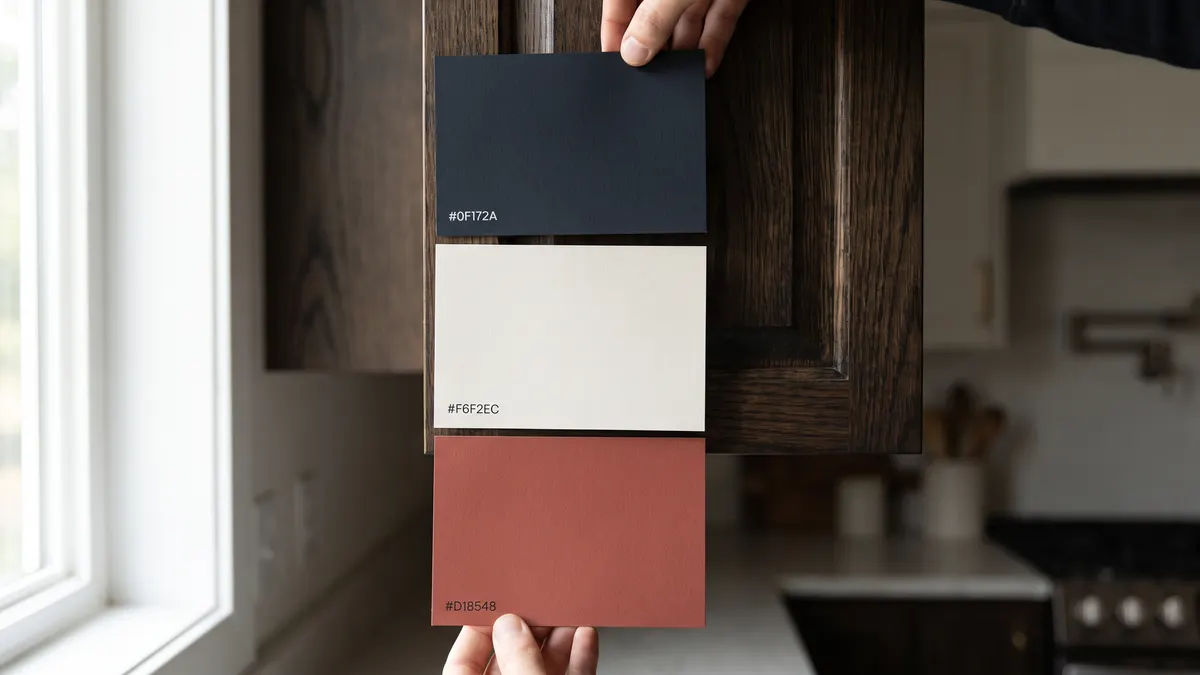
Pick the cabinet color first and let the walls support it, because the cabinets are the largest painted surface in the kitchen and the hardest to change later. If the cabinets are staying natural oak or going a strong color, keep the walls quiet — a soft white or warm neutral — so only one element competes for attention. A kitchen reads as busy when the cabinets, countertop, backsplash and walls all pull in different directions at once; the fix is to let one of them lead and let the rest settle behind it.
Planning cabinet painting & refinishing in west metro Atlanta? Get a free written estimate.
Start with the cabinets — they are the color you cannot easily take back
A kitchen has one dominant color and it is almost always the cabinets. They wrap the room at eye level, they catch the light, and whether they are natural wood or painted, they set the temperature of everything else. Choose them first and the wall color becomes a supporting decision rather than a competing one.
This matters most when the cabinets are a commitment. A lot of the kitchens we work on in the 1990s and 2000s subdivisions around Powder Springs and west Cobb came with golden or honey oak, and that wood throws a strong warm, almost orange cast into the room. You are either keeping that and working with it, or painting over it — and that is the decision that drives the wall color, not the other way around.
Undertones are what make two colors fight
Two neutrals that look identical on a paint chip can clash on the wall, and the reason is almost always undertone. A white can lean yellow, pink, blue or gray; a greige can turn green next to warm wood. Next to golden oak, a cool gray-white goes dingy and the wood looks more orange, because the two are pulling in opposite directions.
The only reliable test is to put real samples against the actual cabinets, countertop, backsplash and floor, and look at them in the morning and again under the kitchen lights at night. Georgia daylight runs warm and most kitchen lighting is warmer still, which pushes a color that looked neutral in the store noticeably warm once it is on the wall.
Let the countertop and backsplash cast the deciding vote
The cabinets are not the only fixed color in the room. The countertop and backsplash are usually staying, and they carry undertones that will either agree with your wall color or argue with it. The speckled builder-grade granite in a lot of these kitchens has beige, gold or brown flecks that quietly pull the whole palette warm whether you planned for it or not.
A simple rule holds up: if one surface is busy, keep the others calm. A backsplash with a lot of pattern or several colors wants quiet walls and simple cabinets. A plain backsplash and solid counters give you room to put a little more color on the walls without the room feeling loud.
Contrast gives a kitchen depth; too much of it makes noise
Matching everything is not the goal — a room with zero contrast feels flat. Light cabinets against a slightly deeper wall, or dark cabinets against a light wall, give the room definition. Natural wood sits well against a soft, earthy wall color that lets the grain read as the feature.
The trick is counting your strong moves. Pick one or two things to make a statement — the cabinets, or a bold backsplash — and let the rest support them. When the cabinets, the counters, the backsplash, the walls and the hardware are all trying to be the loudest thing, the eye has nowhere to rest, and the kitchen feels cluttered even when every individual choice was fine.
If you are painting the cabinets, decide the whole palette at once
Painting cabinets resets the single largest color in the room, so it is the moment to choose the wall color, the cabinet color and the hardware together rather than one at a time. A warm white cabinet against a greige wall reads very differently from the same cabinet against a crisp cool wall, and it is far cheaper to settle that on samples than after two gallons are up.
Sometimes the honest answer is to paint less, not more. If the oak is sound and you actually like warm wood, the cheaper and better move can be to leave the cabinets and only repaint the walls to flatter them. We would rather tell you that than talk you into spraying cabinets you were half-happy with.
Questions we get asked
- Should my cabinets and walls be the same color?
- Usually not. A kitchen with one color on every surface tends to read flat. You want a relationship between the cabinets and walls — close enough to feel intentional, different enough to give the room depth — rather than an exact match.
- What wall color will not look dingy next to white cabinets?
- It depends on the white. Warm whites and creams pair with soft warm neutrals; a cooler, bright white can take a light gray or greige. The failure case is a warm-white cabinet with a cool-gray wall, which makes the cabinets look yellow and the wall look dirty. Sample them side by side before you commit.
- We are keeping our golden oak cabinets — what wall color works?
- Warm, muted colors work with oak instead of against it: soft sage greens, warm greiges and muted earthy tones calm the orange down. Avoid cool grays and stark whites, which make honey oak look more orange by contrast. If the orange itself is the thing you dislike, that is a cabinet-painting conversation rather than a wall-color one.
- Do I have to repaint the trim and ceiling to match?
- Not usually. Trim and ceilings are commonly kept white and act as a neutral break between cabinets and walls. If the existing white is yellowed or clashes with a new cooler palette, repainting the trim can be worth it, but it is a choice, not a requirement.
- Can you help choose the colors, or only paint them?
- We will walk the kitchen with you, hold samples against your cabinets, counters and light, and tell you what we have seen read well and what tends to fight. The final color is yours; we would rather spend the time getting it right on samples than repaint a room that looked different on the wall than it did on the chip.
Reviewed 2026-10-09 by Dan James, WS Painting & Remodeling LLC.