
Should you paint or replace your kitchen cabinets?
Painting beats replacing when the boxes are sound — here is how to tell, and the cases where paint only hides the problem.
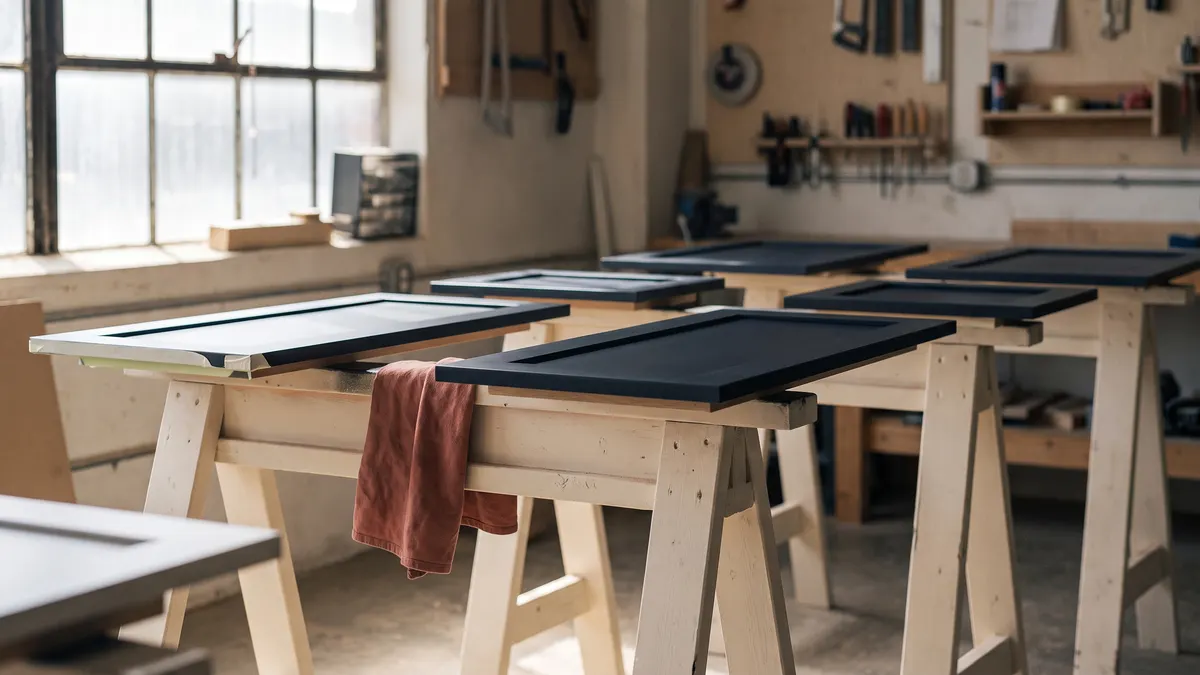
Paint your kitchen cabinets when the boxes are solid and the layout works, and replace them when they are not — that is the whole decision. Painting keeps structurally sound cabinets and resurfaces them, which is why it costs a fraction of replacement, but it only works if the doors and boxes can actually hold a finish. Peeling thermofoil, water-swollen particleboard and a layout you already dislike are the cases where paint is money spent on a problem you will still have afterward.
Planning cabinet painting & refinishing in west metro Atlanta? Get a free written estimate.
Painting wins when the cabinet is sound
Most kitchen cabinets outlast their finish by decades. The boxes — the frames and carcasses fixed to your walls — are usually built from plywood or particleboard with solid-wood face frames, and they are rarely the thing that is actually worn out. What is worn out is the finish: dated color, grease-dulled sheen, chipped edges around the handles. That is a painting problem, not a replacement problem.
The quick test is physical. If the doors still close square, the frames are solid, the drawers run, and there is no water damage, the cabinets are a candidate for paint. You keep the layout and the structure and change the thing you actually dislike, which is the color — for a fraction of what tearing them out and starting over costs.
Oak will tell on a cheap paint job
The open, wavy grain of oak is the detail that catches people out. Those 1990s honey-oak kitchens all over west Cobb have deep grain lines, and paint does not fill them — it follows them. Spray two coats of enamel over bare oak and you still see every grain line telegraphing through the smooth color, which reads as an obvious painted-oak finish rather than a clean one.
The fix is grain filler: the grain is filled and sanded flat before primer, so the final surface comes out smooth. That is real labor and it is a choice. Some owners like the grain showing because it still reads as wood; others want the flat, modern look and are surprised to learn it is extra work, not a different can of paint. Either is fine as long as you decide it on purpose.
Thermofoil and melamine need a bonding primer, or the paint peels
Not every cabinet is wood. Thermofoil doors are a vinyl film heat-pressed over an MDF core, and melamine and laminate are a hard, plastic-like surface over particleboard. Both are deliberately slick, which is exactly what paint needs not to be. A standard primer will not grip them, and a finish that cannot grip peels at the edges within months.
These surfaces can be painted, but only with a dedicated bonding primer made to stick to slick substrates, after a thorough degrease and scuff. Skip that one step and the job fails. This is the case where the prep products matter more than the paint, and where a cut-rate quote usually means the bonding step was the thing left out.
When peeling thermofoil means replace the doors, not paint them
There is a point where thermofoil is past painting. The film lifts and bubbles over time, usually along the top edges of the doors next to the oven or above a dishwasher, where heat and steam work their way behind it. Once that film is peeling or blistering, there is no sound surface to paint — you would be coating a layer that is already letting go of the door.
The honest answer there is to replace the doors rather than paint them. The good news is you can often keep the boxes and the layout and just order new doors and drawer fronts, which is still well short of a full replacement. We would rather tell you a door is a replacement than take your money to paint something that will peel anyway.
The cases where replacing the cabinets is the right call
Paint does not fix geometry or rot. If the box under the sink is swollen and crumbling from a slow leak, if cabinets sag or pull away from the wall, if doors are missing after a wall came out, or if you simply hate the layout, no finish solves that. Water-damaged particleboard in particular keeps failing no matter what goes on top of it.
Those are replacement conversations, and we will say so. Cost is the other half of the decision — painting is dramatically less than new cabinetry, but the gap depends on your kitchen, so the cost guide is the place to see honest ranges rather than a number we would only have to hedge here.
What good prep actually involves
A durable cabinet finish is almost all preparation. The faces are degreased — cooking residue near the range is the single most common reason a DIY cabinet job peels — then scuff-sanded, filled, primed with the right primer for the material, and finished with a hard cabinet enamel that cures far harder than wall paint. Doors are labeled, removed and ideally sprayed off the cabinet so they lay out flat and level.
Done that way, painted cabinets hold up to daily handling for years. Done without the degrease, the sanding or the correct primer, they look good for a season and then chip and peel at every edge you touch. The difference between those two outcomes is entirely in the steps you cannot see once the job is finished.
Questions we get asked
- Will painted oak still show the grain?
- Only if you want it to. Left as-is, the oak grain telegraphs through the paint and reads as painted wood. Filled and sanded first, the surface comes out smooth and modern. It is a prep decision with real labor attached, so tell your painter which look you are after before they quote it.
- Can thermofoil cabinets be painted at all?
- Yes, if the film is still fully bonded, using a bonding primer made for slick surfaces after a proper degrease and scuff. If the thermofoil is already lifting, bubbling or peeling, painting it is a waste — those doors should be replaced instead, usually while keeping the existing boxes.
- My cabinets are particleboard — can they be painted?
- Painted faces and solid particleboard boxes take paint fine with the right primer. The exception is particleboard that has gotten wet and swollen, commonly under the sink; that material has lost its integrity and should be repaired or replaced, because paint will not restore it.
- How much cheaper is painting than replacing?
- Significantly, because you are keeping the boxes, the layout and the installation and only resurfacing what shows. The exact gap depends on your kitchen size and condition, so the cabinet-painting cost guide is the right place for honest ranges rather than a single figure.
- Will a painted finish hold up by the stove and sink?
- Yes, when it is degreased properly and finished with a hard cabinet enamel. Those high-use zones are exactly where skipped prep shows first, so the areas by the range and sink are the ones that prove whether the job was done right.
Reviewed 2026-10-09 by Dan James, WS Painting & Remodeling LLC.