
Choosing a house color around what you can't change
A color does not live on the swatch, it lives on your house next to the roof, brick, and stone you are keeping. Name those first and the choice gets easier.
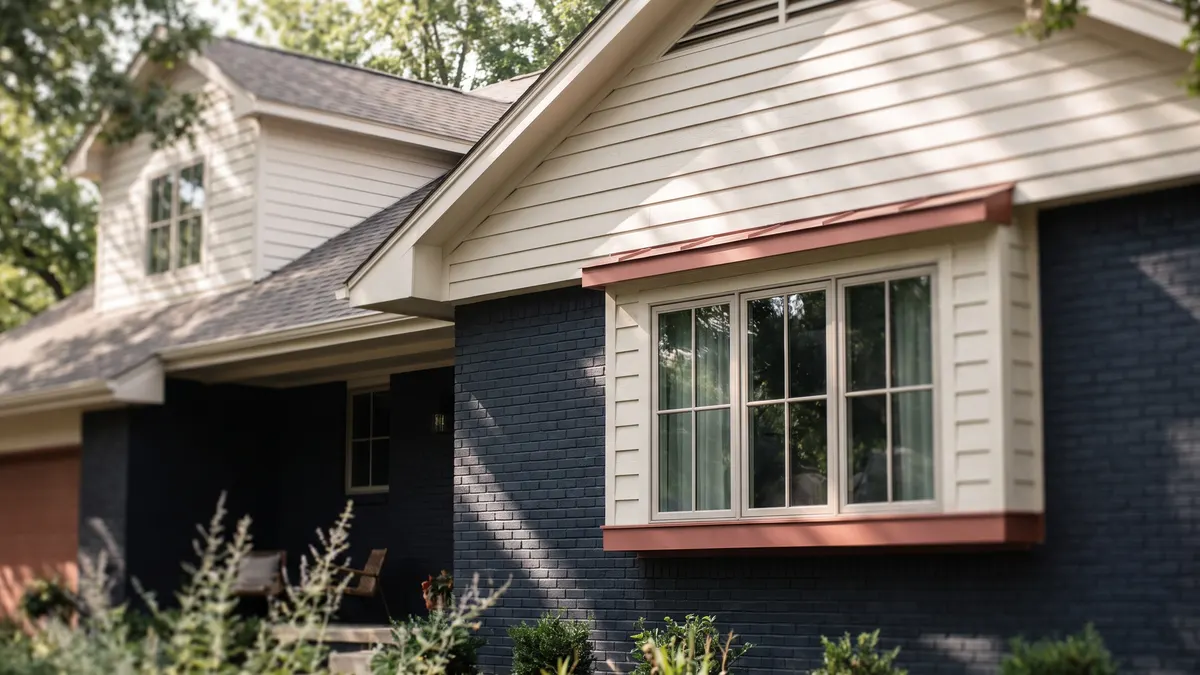
The most common exterior color mistake is choosing a body color in isolation and ignoring the things you are not repainting: the roof, the brick or stone, the permanent masonry, and the houses on either side. Those fixed elements set the undertone you have to live with, so a gray that looks clean on a swatch can turn muddy next to a brown roof or cold next to red brick. Start by naming everything that is staying, hold your options against it in real daylight, and choose the color that works with the roof and masonry instead of fighting them.
Planning exterior painting in west metro Atlanta? Get a free written estimate.
The constraint everyone forgets
People choose exterior color the way they choose a shirt, by looking at the color they want. But a house is never a blank wall. You are painting the siding and the trim, and you are almost certainly not painting the roof, the brick or stone, the chimney, the stonework on the foundation, or the driveway and walk. Those stay, and they have strong colors of their own that your new body color has to live beside for years.
This is the step that gets skipped, and it is the one that decides whether the result looks considered or off in a way the owner cannot name. The color does not exist on the swatch; it exists on your house, next to everything you are keeping. Name those fixed elements first, and the color choice gets both easier and better.
The roof sets the temperature
The roof is usually the largest fixed color on the house, and it quietly rules what the body can be. Roofs read warm or cool: brown, tan, and weathered-wood shingles are warm; true gray, black, and blue-gray shingles are cool. A warm roof fights a cool body color, so a crisp blue-gray paint under a brown roof often looks like two houses arguing, and a cool roof can make a warm beige look dingy.
The move is to match the temperature, not the color. Under a brown or tan roof, body colors with a warm undertone sit comfortably, including warm grays, greiges, soft greens, and muted tans. Under a true-gray or black roof, cooler grays and blues have room to work. You do not have to love your roof; you do have to paint in agreement with it until you replace it.
Brick and stone have an undertone
West-metro Atlanta has a lot of brick fronts with sided gables and rear walls, and partial brick is the trickiest fixed element of all, because brick is rarely neutral. It leans pink, orange, red, salmon, or buff, and that undertone will either be flattered or exposed by the body color next to it. An orange-leaning brick, common on houses from the 70s through the 90s here, turns louder next to a cool gray and calmer next to a warm, muted body color that shares its temperature.
The test is to hold large samples directly against the brick or stone in daylight and look at the undertone, not the main color. Stone veneer on the newer and upper-end houses usually carries several tones at once, which gives you more to pull from but also more to clash with. Pick a body color that picks up one of the quieter tones in the masonry, and the whole front reads as one house.
Test in Georgia daylight, not on a chip
A paint chip under store lighting is almost useless for an exterior. Color outdoors changes with the sun, our light is bright, and the greenery around most houses throws its own cast onto the walls. The only reliable test is a large sample, at least a couple of feet square and bigger if you can, painted directly on the house rather than a card held near it.
Put samples on more than one wall, because the same color reads differently on a shaded north face and a sun-blasted south one, and look at them across a full day; what looks soft and right at noon can go stark at five o'clock. One choice caveat worth weighing here: very dark body colors can show fade and chalking sooner on the sun faces, so commit a whole house to a deep color only with that trade-off in mind, ideally with a painter looking at the house alongside you.
- Sample size at least two feet square, painted on the house and not on a card.
- Samples on both a shaded and a sunny wall, viewed morning and late afternoon.
- Check the body color directly against the roof, the brick or stone, and the trim you are keeping.
The street is a fixed element too
The houses on either side are part of what you are not changing, and they frame yours whether you like them or not. This is not about matching the neighbors, since a street of identical houses is its own problem, but about knowing where yours sits. A color that would be handsome in isolation can look jarring wedged between two quiet facades, and a too-timid color can disappear on a lively street.
The aim is to fit the block and then be the best-kept house on it, not the one that announces itself. If a subdivision has a homeowners association, its palette rules are a separate matter to check with them directly; here we are talking only about the visual judgment of sitting well among your neighbors.
The newer the subdivision, the more this matters, because builder streets often share a narrow range of body colors on purpose, and a house that jumps too far from that range reads as the odd one out even when the color is good on its own. Older and more varied streets give you more room. Walk the block before you commit, and judge your top choice against the houses that will actually flank it, not against a showroom wall.
The same discipline works inside
The principle that saves an exterior also saves an interior: choose color around what you are keeping. Inside, the fixed elements are the floors, the cabinets, the countertops, the tile, and the fireplace surround, the things that cost far more to change than a wall of paint. A wall color chosen to love on its own can fight the undertone of a wood floor or a tile you are stuck with.
So the method carries over. Name the finishes that are staying, pull your paint options against them in the room's actual light, and choose the one that agrees with the floor and the cabinets rather than the one that looked best on the fan deck. Whether the surface is brick outside or oak inside, the color that works is the one chosen in context, not in a vacuum.
Questions we get asked
- How do I pick an exterior color that goes with my roof?
- Match the temperature, not the color. If the roof is brown, tan, or weathered-wood, it reads warm, so warm grays, greiges, and muted earth tones sit well under it. If it is true gray or black, cooler grays and blues have room to work. A body color that fights the roof's temperature is the most common reason a scheme looks slightly off.
- My brick is an orange-ish color, what body colors work with it?
- Orange-leaning brick calms down next to warm, muted body colors that share its temperature and gets louder next to cool grays. Hold large samples right against the brick in daylight and judge the undertone, not the main color. A body color that picks up one of the quieter tones in the brick ties the front together.
- Should I match my neighbors' house colors?
- No, since matching is its own problem, but know where your house sits on the street, because the neighbors frame it. Aim to fit the block and be the best-kept house on it rather than the one that stands out for clashing. A color handsome in isolation can look wrong wedged between two quiet facades.
- How big should a paint sample be and where do I put it?
- At least two feet square, painted directly on the house rather than held up on a card, and put samples on both a shaded and a sunny wall. Look at them morning and late afternoon, since the same color shifts with the light. A chip under store lighting tells you almost nothing about how it will read outdoors.
- Do I have to coordinate my interior and exterior colors?
- They do not have to match, and usually should not be driven by each other. What carries over is the method: inside, choose wall colors around the floors, cabinets, and tile you are keeping, the same way you choose a body color around the roof and brick outside. Context decides the color in both places.
Reviewed 2026-10-09 by Dan James, WS Painting & Remodeling LLC.