
What makes a deck last: the parts you can't see
The footings, the ledger and the framing connections decide a deck's life; the boards you walk on are the cheapest part to replace.
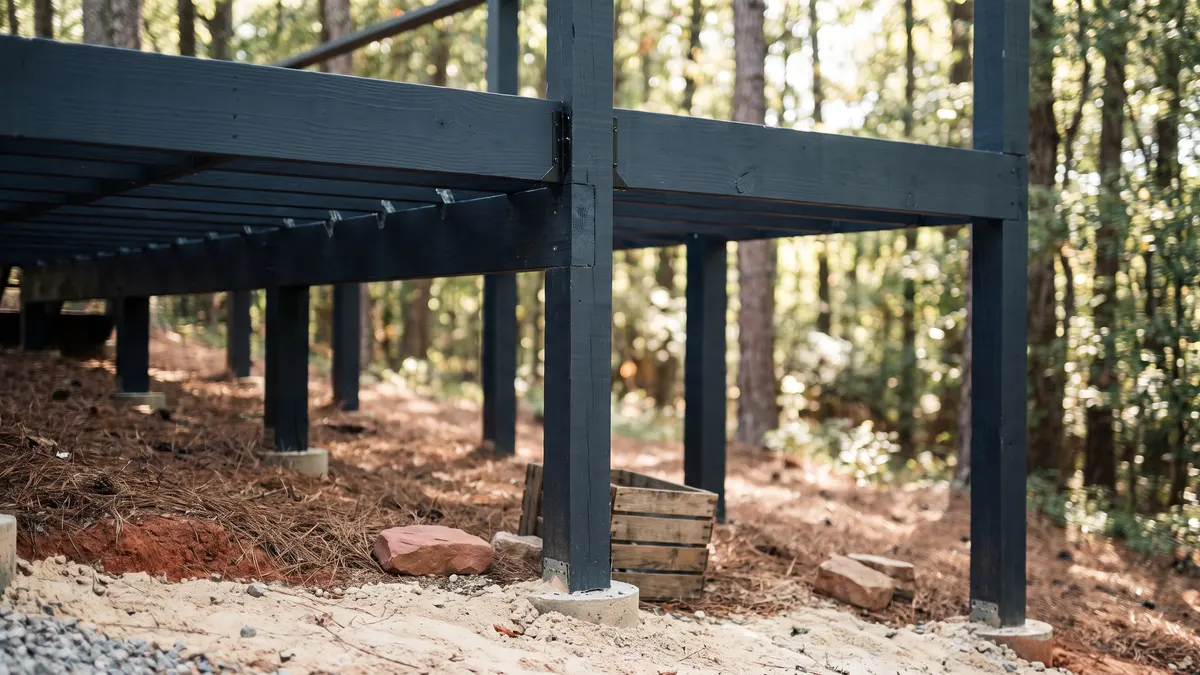
A deck's life is decided by the parts you cannot see: the footings in the ground, the ledger where it bolts to the house, and the metal connections in the frame. The decking boards are the cheapest, most replaceable part. In west-metro Atlanta, red clay that holds water and termites that work year-round attack the substructure, so a 1990s cedar deck with a nailed ledger and posts set in dirt is usually a rebuild, not a repair — even when the boards still look walkable.
Planning deck & porch building in west metro Atlanta? Get a free written estimate.
The ledger is where decks fail
If a deck attaches to the house, the single most important connection is the ledger — the board bolted to the house that carries one whole edge of the deck. When attached decks fail catastrophically, this is almost always where it starts, and it is also the part homeowners never look at.
Two things separate a ledger that lasts from one that does not. First, it has to be bolted through the house's rim joist, not nailed — nails pull out slowly under load and fast under a crowd. Second, it has to be flashed so water sheds out over it instead of running down behind it into the band of framing it is attached to. A ledger that was nailed on and never flashed is quietly rotting the house itself, not just the deck, and no amount of new decking changes that.
Footings and posts in Georgia clay
The other half of a deck's safety is in the ground. Posts carry the load down to footings, and footings have to reach stable soil and spread the load so the deck does not settle or lean. Georgia red clay complicates both: it holds water, swells and shrinks with the seasons, and drains slowly, so undersized or shallow footings can heave and move.
The common failure on older decks is simpler than that. Posts were set straight into the dirt, or onto a pad with no real connection, and the wood wicks ground moisture and rots from the bottom up while termites work the rest. A sound deck sets posts on proper footings with metal connectors that hold the wood up off the concrete, so water drains away instead of sitting against end grain.
Why a failing 90s cedar deck is a rebuild
A lot of the decks in west-metro subdivisions went up with the houses in the 1990s, and many were cedar. Cedar is a good-looking deck wood, but after a couple of decades in this climate it has usually given what it has to give, and it is rarely just the surface that is tired.
The problem is that the whole structure is the same age and was built to the standards of its day — which often means a nailed ledger, little or no flashing, posts in contact with soil, and connectors that have since rusted. You cannot buy back a sound substructure by replacing the boards on top of it. When the frame, the ledger and the footings are all at the end of their run, the honest answer is a rebuild, because a repair would be new boards resting on the exact failures that make the deck unsafe.
When a repair genuinely makes sense
None of this means every old deck is a teardown. If the substructure checks out — a properly bolted and flashed ledger, footings and posts that are sound and dry, framing and connectors in good shape — then tired, cupped or splintered boards are exactly what you replace, and only that. Re-decking a sound frame is a real option and a much smaller job than a rebuild.
That is the point of looking underneath before quoting a direction. We would rather tell you the frame is good and reboard it than sell a rebuild the structure did not need. The only way to know which conversation you are having is to get under the deck and check the connections, not to judge it from the surface you walk on.
Choosing the surface, and the staining wait
Once the structure is settled, the decking material is a comfort-and-upkeep decision rather than a safety one. Pressure-treated pine is the lowest upfront cost and holds up structurally, but it needs staining and resealing on a cycle to look right. Cedar is softer and warmer-looking with its own upkeep. Composite costs more upfront and skips the staining entirely, though it runs hot underfoot in direct Georgia sun.
One timing detail trips people up: a new pressure-treated deck is wet from the treatment and has to dry out before it takes stain, which can mean waiting several weeks to a few months depending on the weather. Staining it too soon traps moisture and the finish fails early. If someone offers to stain a brand-new treated deck the week it is built, that is a reason to slow down, not speed up.
Questions we get asked
- How do I know if my old deck is still safe?
- Look at the connections, not the boards. Check whether the ledger is bolted and flashed or just nailed, whether the posts sit on footings or in dirt, and whether the metal connectors are solid or rusted. Any movement, sponginess underfoot, or wood you can push a screwdriver into is a reason to have it looked at before you use it again.
- Can you just replace the boards and keep my deck?
- Yes, if the structure underneath is sound. Re-decking a good frame is a legitimate, smaller project. It only stops being an option when the ledger, footings or framing are the things that have failed, because new boards cannot fix the parts that carry the load.
- Is pressure-treated wood or composite better here?
- Pressure-treated pine costs less upfront and needs regular staining; composite costs more and skips the staining but gets hot in direct sun. Both work in Georgia. The structure under either is what determines how long the deck lasts, so the surface is mostly a question of how much upkeep you want.
- Do I need a permit to build or rebuild a deck?
- Attached and elevated decks typically involve a permit and an inspection of the footings and framing before the decking covers them, but requirements vary by jurisdiction. The contractor who builds it generally handles that paperwork and can tell you what applies at your address.
- When can I stain a newly built pressure-treated deck?
- After it has dried out from the treatment, which usually takes several weeks to a few months depending on the weather. Staining before it is dry traps moisture and causes the finish to fail, so the wait is doing real work even though it is frustrating.
Reviewed 2026-10-09 by Dan James, WS Painting & Remodeling LLC.