
How to keep paint colors flowing from room to room
Choosing color room by room is how a house ends up disjointed. Here is how to pick a palette that reads as one home across the sightlines.
Choose one main color for the connected spaces you can see at once, because in an open floor plan the kitchen, dining and living areas read as a single room and cannot each take a different strong color without fighting. Keep the trim and ceilings the same white through the whole house to tie it together, keep every undertone on the same side — all warm or all cool — so adjacent colors agree through a doorway, and save the bolder choices for bedrooms and other rooms that close off. Judge the colors standing where you can see the most rooms at once, not one wall at a time.
Planning interior painting in west metro Atlanta? Get a free written estimate.
Pick color for the sightline, not the single room
The mistake that makes a freshly painted house feel busy rather than refreshed is choosing each room on its own. You stand in the dining room with a chip, pick a color you like, then do the same in the kitchen and the living room, and end up with three colors that were each fine alone and argue the moment you can see all three through a doorway.
The open floor plans in the 1990s and 2000s subdivisions around Powder Springs make this unavoidable. The kitchen, breakfast area and great room are one connected space with no wall between them, so they are really one surface to paint, not three rooms. The first decision is not a color — it is drawing the line around everything you can see at once and treating it as a unit.
Let the trim and ceilings carry the whole house
The quiet thread that makes a home feel considered is one trim color used everywhere. When the baseboards, casings, doors and crown are the same white in every room, the eye reads continuity even when the wall colors change behind them. Switching trim color room to room does the opposite and makes each space feel stitched on.
Ceilings work the same way. A consistent ceiling color overhead lets the walls change underneath without the house feeling chopped up. Pick the trim white and the ceiling once, commit to them through the whole floor, and the wall colors have a frame to sit inside.
Keep every undertone on the same team
Colors that flow share an undertone. A warm greige in the living room and a cool gray in the hall will fight across the opening between them, because one is pulling yellow and the other blue, and your eye catches the disagreement at the seam. Decide early whether the house is running warm or cool and hold that line across the connected spaces.
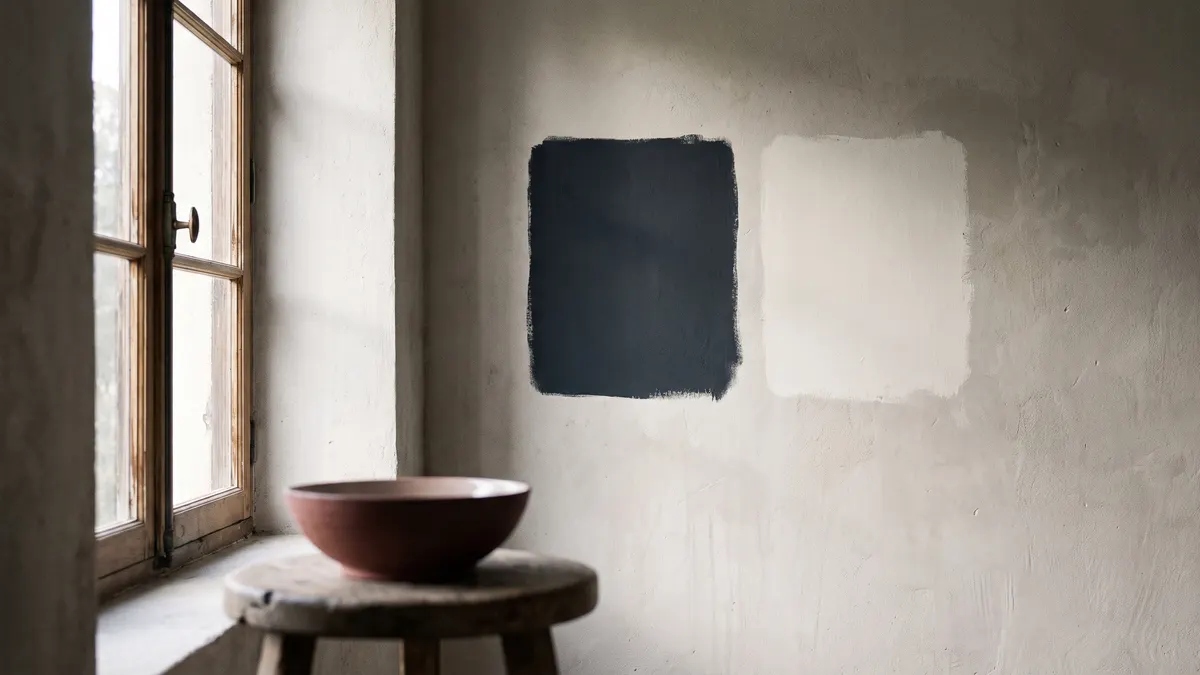
This is easier to get right with samples than with chips, because an undertone that is invisible on a small card shows up once the color is on two walls that meet at a corner. Paint a patch on each side of a doorway and look at them together — if one suddenly looks dirty next to the other, they are on opposite teams.
The floor runs through everything, so build on it
Wall color can change at a doorway. The floor usually cannot. Hardwood, luxury vinyl plank or tile commonly runs continuous across the whole main level, which makes it the one color present in every connected room — and the one the palette has to agree with everywhere, not just in the room you are standing in.
A red-oak floor carries a warm orange cast down every hallway it reaches, so a cool-gray scheme that looks crisp on the chip can read cold against it in room after room. Choosing a wall palette that sits with the floor you already have is its own decision, and it is worth getting right before you pick a single wall color.
Where you can break the rule
Rooms that close off are where you get to loosen up. A bedroom behind a door, a powder room, an office or a nursery is not part of the main sightline, so it can take a deeper or more personal color without pulling against the rest of the house. The closed door is the permission.
The honest version of this: most of a house wants a calm, continuous palette, and a few contained rooms are where color gets to be an event. Trying to make every room a statement is what leaves a home feeling restless instead of renewed.
Test it the way you actually live in it
Before you buy gallons or book the painters, put large samples up in the connected spaces and then go stand in the worst spot — the place where you can see the most rooms at once, usually the middle of the open floor plan. That single view is what a flowing palette has to pass, and it is the view a chip on a counter never shows you.
Look at it in the morning and again in the long Georgia afternoon, because the light that pours through the back of an open plan changes the colors together as the day moves. A palette that holds across that one sightline at both times of day is one that will feel like one home for years.
Questions we get asked
- Should every room in the house be the same color?
- No — only the connected spaces you see at once need to share a color. Rooms that close off with a door can vary. The goal is continuity across sightlines, not a single color everywhere, which tends to feel flat.
- How many wall colors should a whole house have?
- Fewer than most people expect. One main color for the open living areas, the same trim and ceiling throughout, and then a handful of deeper or more personal colors in the closed rooms is usually plenty for a house to feel cohesive rather than busy.
- Do the trim and ceiling really have to match in every room?
- They do not have to, but keeping the trim one white through the house is the single easiest way to make different wall colors feel like they belong together. It is the thread the eye follows from room to room.
- How do I keep an open kitchen and living room from clashing?
- Treat them as one space, because that is how they read. Paint them the same color, or keep the walls one color and let an island or furniture carry any contrast. Two different strong wall colors meeting with no wall between them is what looks off.
- Can you help pick a palette that flows, or only paint it?
- We will walk the main level with you, hold samples up across the sightlines and at the doorways where colors meet, and tell you what tends to read as one home and what tends to fight. The colors are yours; we would rather settle them on the wall than after the gallons are open.
Reviewed 2026-10-09 by Dan James, WS Painting & Remodeling LLC.